
Hair Extension Manufacturer Grades
The aim of HairExtensionShop.ie is not only to offer customers a wide selection, but also to help them understand what makes one type of hair different from another. A well-chosen hair extension can provide a more natural look, a more beautiful fall, easier manageability, and, with proper care, a longer lifespan.
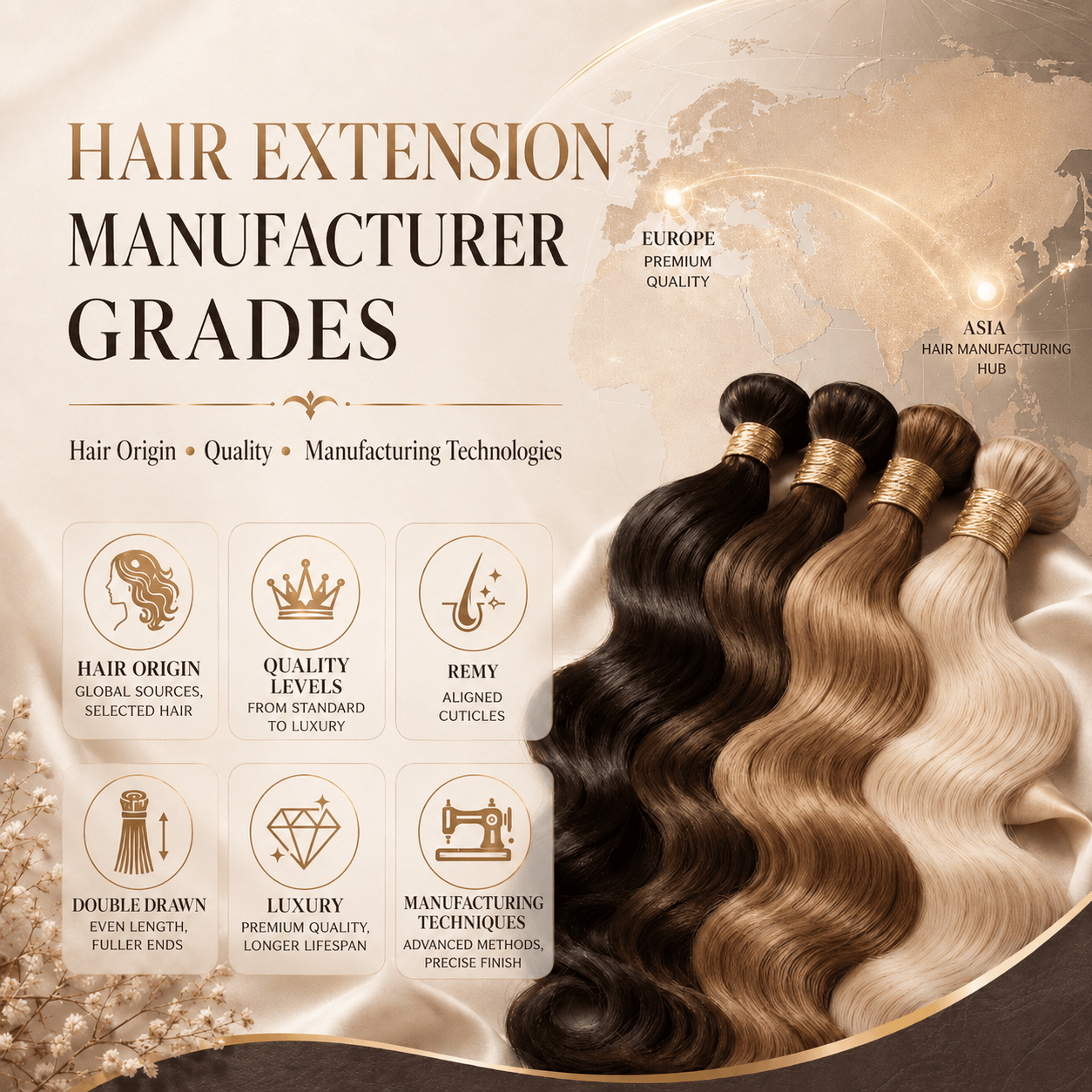
HairExtensionShop.ie Professional Guide
How Do Hair Extension Manufacturers Sort Hair? – Manufacturer Grades, Hair Origin and Quality Secrets
The quality of hair extensions is not created by chance. Behind beautiful, natural-looking and easy-to-manage hair extensions, there is a long process of sorting, cleaning, processing and quality control. When a customer chooses clip-in hair extensions, keratin hair extensions, weft hair, I-Tip hair extensions or Tape-In hair extensions, they are not only choosing a colour and length, but also the result of an entire manufacturing and quality background.
The aim of HairExtensionShop.ie is not only to offer customers a wide selection, but also to help them understand what makes one type of hair different from another. A well-chosen hair extension can provide a more natural look, a more beautiful fall, easier manageability, and, with proper care, a longer lifespan.
In this article, we explain how manufacturers sort hair extensions, which countries are considered important manufacturing or raw hair centres, what the reputation of Russian / Slavic hair means, which hair types may be the most valuable, and which manufacturing techniques are considered especially difficult in the world of hair extensions.
Hair OriginThe source of the raw hair can influence texture, colour, strength and processing potential. |
Remy DirectionAligned cuticles can support a smoother feel, easier brushing and reduced tangling. |
Manufacturing QualitySorting, processing, colouring and attachment technology together define the final quality. |
How Do Hair Extension Manufacturers Sort Hair?
One of the most important stages in hair extension manufacturing is sorting. High-quality hair extensions are not valuable simply because they are made from “human hair”. The real difference comes from where the hair was collected, how uniform the strand direction is, what condition the hair fibres are in, how many shorter strands are present, and how carefully the hair has been processed.
Manufacturers usually sort hair according to the following criteria:
- hair length,
- hair colour,
- hair thickness,
- strand direction,
- cuticle condition,
- hair texture,
- dyed or undyed condition,
- chemically processed or natural hair,
- the proportion of shorter strands,
- fullness of the hair ends,
- cleanliness and processing suitability.
Better manufacturers separate hair by length, texture and quality, then clean, disinfect, comb, classify and process it according to the final product type. In a quality manufacturing process, hair is sorted through several stages so that the final result is more uniform, more natural-looking and easier to manage.
Why Are Strand Direction and the Cuticle Important?
For high-quality human hair extensions, one of the most important factors is the direction of the hair strands. The outer layer of the hair fibre is the cuticle, which consists of tiny scale-like layers. If the strands remain aligned in the same direction, the hair can feel smoother, fall more beautifully and become less prone to tangling.
This is why Remy hair is more valuable. The essence of Remy hair is that the cuticle direction of the hair strands is more organised, meaning the strands generally run in one direction. This can help hair extensions look more natural, brush more easily and last longer with proper care.
By contrast, with lower-quality or more heavily processed hair, the strand direction may be less organised. This can lead to a greater tendency to tangle, a drier feel or a shorter usable lifespan.
What Does Manufacturer Quality Grading Mean?
Hair extension manufacturers may use several internal quality categories. These are not always standardised, but they usually take the following factors into account:
1. Origin of the raw hair
Temple Indian hair, raw Vietnamese hair, processed Chinese hair, European hair or Slavic hair may each represent a different value. However, origin alone does not automatically mean good or poor quality.
2. Level of processing
The fewer chemical treatments the hair has undergone, the more natural its structure may remain. Excessive acid treatment, silicone coating or strong bleaching can give impressive shine in the short term, but may weaken the quality of the hair over time.
3. Alignment of strand direction
Remy-type hair with organised strand direction is more valuable because it is easier to manage and less prone to tangling.
4. Proportion of shorter strands
The more shorter strands the hair contains, the thinner the ends may appear. In better categories, manufacturers pay greater attention to keeping the proportion of shorter strands lower.
5. Fullness of the hair ends
Single Drawn hair may show a more natural tapering at the ends. With Double Drawn and Super Double Drawn hair, the ends appear visibly fuller because more shorter strands are sorted out.
6. Final product type
A different technology is needed for clip-in hair extensions, another for keratin hair extensions, another for Tape-In hair extensions, and a completely different level of expertise is required for hand-tied wigs or premium lace closure / frontal products.
Where Are the Largest Hair Extension Manufacturers Located?
The hair extension industry is global and complex. It is important to distinguish between the origin of the raw hair and the place where the finished hair extension product is manufactured. Hair often originates from one country, is processed in another country, and is sold under the brand name of a third country.
The most important players include the following:
India – One of the Largest Sources of Raw Human Hair
India is a key player in the global raw human hair market. A significant part of the hair comes from temple offerings, hair collection and various commercial channels. According to World Bank WITS data, India exported more than 187 million USD worth of raw human hair and hair waste in 2023.
Indian hair is popular because in many cases it is naturally wavy, processable and available in large quantities. Temple Remy hair can be especially valuable if the direction of the hair strands is preserved and the processing is gentle.
China – A Major Processing and Manufacturing Centre
China is one of the most important manufacturing centres for finished hair products, wigs, hair extensions and synthetic hair products. In many cases, raw hair arrives from another country and is then sorted, coloured, disinfected, wefted, tipped, taped, bonded or transformed into finished products in China.
In the international hair industry, China is especially strong in high-volume manufacturing, colour processing, various attachment technologies and the production of mass-market hair extension products. Several industry sources also refer to China as one of the key processing centres in the hair extension and wig manufacturing market.
Vietnam – A Growing Premium Raw Hair and Manufacturing Centre
Vietnamese hair has become increasingly popular in the international market in recent years. Many traders and customers consider Vietnamese hair to be strong, thicker-stranded, naturally beautiful and durable raw material. Vietnam plays a significant role in the export and processing of premium human hair, although official trade statistics may vary depending on whether the category refers to raw hair, processed hair, wigs or hair extensions.
Vietnamese hair can be an especially good choice when the goal is a natural, darker, stronger and more durable hair extension result. For light blonde shades, however, stronger lightening is usually required, which may affect the hair structure.
Myanmar, Cambodia, Indonesia and Other Southeast Asian Sources
Several Southeast Asian countries are also important hair sources. Hair from these regions is often naturally darker, stronger and thicker-stranded. Quality can vary significantly here as well: carefully collected hair in good condition can be valuable, while mixed, heavily processed or less controlled raw material may represent a lower category.
Europe, Russia and Slavic Hair – Rare, Expensive, but Not Always “the Best”
European, Slavic or Russian hair has long had a special reputation. This is because genuine Slavic hair is often finer, lighter in tone, may blend more naturally with European hair types, and may require less lightening to achieve blonde shades.
This can be a real advantage, for example, with light blonde, ash blonde or platinum blonde hair extensions. At the same time, genuine Slavic / Russian hair is rare, very expensive, and the term is often overused in marketing. Several professional sources warn that “Russian hair” or “Slavic hair” is not always used as a true indication of origin, and suspiciously cheap “Russian hair” products should be approached with particular caution.
Is Russian Hair Really the Best?
The answer is: it can be outstanding in certain respects, but it is not always the best choice for every customer or every purpose.
Advantages of genuine Russian or Slavic hair:
- it may be finer in texture,
- it may naturally occur in lighter shades,
- it can blend beautifully with European hair types,
- it may require less bleaching for light shades,
- it can provide a very natural effect when processed at a premium level.
However, it is important to understand its limitations:
- it is very rare,
- it belongs to a high price category,
- there is a lot of misleading “Russian hair” marketing,
- it is not necessarily the best choice for a thicker, fuller effect,
- for darker, stronger and more durable hair, Vietnamese, Indian or other Asian-origin Remy hair can also be an excellent option.
Therefore, the statement that “Russian hair is the best” is more a combination of an old premium-industry stereotype and a partly true professional observation. Genuine Slavic hair can be luxury-grade raw material, but quality is not determined by nationality alone. The method of collection, strand direction, processing, degree of chemical treatment, sorting and final manufacturing technology are at least as important.
Which Country’s Hair Is Best for Hair Extensions?
There is no single universal answer. The “best hair” depends on what you want to use it for.
The Real Answer
The best hair extension is not defined simply by “which nation’s hair” it is, but by:
- the condition in which it was collected,
- whether it is Remy-type or non-Remy hair,
- how well the strand direction is aligned,
- how many shorter strands it contains,
- how gently it was processed,
- how well it matches the customer’s own hair,
- what purpose it is intended for.
This is why well-sorted Vietnamese or Indian Remy hair can often be a better choice than a poorly processed product with uncertain origin advertised as “Russian hair”.
Which Manufacturing Techniques Are the Most Difficult?
In hair extension manufacturing, not every product is made with the same level of difficulty. Some techniques are simpler, while others require a particularly high level of expertise.
1. Preserving Remy strand direction
One of the most difficult tasks is preserving the direction of the hair strands. If the strands become mixed, the hair may tangle more easily. Producing high-quality Remy hair therefore requires great attention from collection through cleaning to packaging.
2. Double Drawn and Super Double Drawn sorting
Creating Double Drawn hair is time-consuming because a significant proportion of shorter strands is sorted out to make the hair ends fuller. Super Double Drawn may mean an even higher level of sorting, where a greater proportion of the strands are close to the same length.
This is difficult because less premium finished product is created from a larger amount of raw material. Sorting requires more working hours, more manual labour and greater raw material loss. Several professional materials about Double Drawn technology also highlight that removing shorter strands results in fuller, more even hair ends.
3. Creating light blonde shades
Lightening dark human hair is especially difficult. Producing ash blonde, platinum blonde, light blonde and extra-light shades requires strong expertise, because excessive lightening can damage the hair fibre structure.
This is why raw material that is naturally lighter, or can reach the desired shade with less chemical processing, is more valuable.
4. Keratin hair extensions and I-Tip / U-Tip production
With keratin hair extensions, the preparation of the hair tips, as well as the amount, shape and adhesion of the keratin, are especially important. Poorly made keratin tips may crumble more easily, slip or melt unevenly during application.
For I-Tip, U-Tip and Flat-Tip hair extensions, precise machine and manual work is required, because every strand should be close to identical in weight, shape and stability.
5. Tape-In hair extension manufacturing
With Tape-In hair extensions, hair distribution, adhesive strip quality, tape thickness and strand direction together determine the final result. Good Tape-In hair extensions lie flat, feel comfortable, look natural and may be re-taped with proper care.
Modern thinner or injected Tape-In technologies require especially precise manufacturing, because the goal is to make the extensions as discreet as possible in the customer’s own hair.
6. Hand-tied wigs, lace front and closure products
The most labour-intensive technologies include hand-tied wigs, lace front, closure and frontal production. In these cases, the hair strands are attached by hand to a fine base to create a natural root effect. This is extremely time-consuming work requiring great manual skill and quality control.
What Should Customers Pay Attention To?
When buying hair extensions, it is worth looking beyond how premium the product name sounds. It is much more important that the product description is clear and realistic.
It is worth checking:
- whether the product is human hair, mixed fibre or synthetic hair,
- whether the hair is Remy-type,
- which quality category it belongs to,
- how thick the hair ends are,
- whether it is recommended for occasional or longer-term use,
- whether it can be dyed or heat styled,
- what kind of care it requires,
- which attachment technology it uses,
- whether the product description sets realistic expectations.
A reliable online store does not only want to sell hair extensions, but also helps customers understand which type of hair is suitable for which purpose. The Standard category can be a good affordable solution, Classic may offer better manageability, while Premium and Luxury categories are designed for customers looking for a higher-quality experience.
HairExtensionShop.ie – Professional Selection for Retail and Wholesale Customers
The aim of HairExtensionShop.ie is to offer customers a transparent, professionally structured and continuously expanding range of hair extensions. Our selection includes different attachment technologies, hair lengths, colours and quality categories, so every customer can find a solution that matches their needs.
Our online store also provides retail and wholesale service, so we can be a professional partner for individual customers, hairdressers, beauty salons and resellers alike.
By continuously expanding our range, we aim to make HairExtensionShop.ie one of the most comprehensive hair extension suppliers, whether customers are looking for clip-in hair extensions, weft hair, keratin hair extensions, Tape-In hair, I-Tip hair extensions, wigs or hair extension accessories.
Summary – Good Hair Extensions Are Not Only About Origin, but Also Sorting and Processing
The quality of hair extensions is not determined by a single factor. It is not enough to look at whether the hair is Indian, Vietnamese, Chinese, Russian or European in origin. True quality is created through the combination of collection, sorting, strand direction, processing, hair-end fullness, attachment technology and quality control.
Genuine Russian or Slavic hair can be exceptionally beautiful and valuable, especially for lighter European hair types, but it is not always the best or most practical choice. Well-sorted Indian, Vietnamese or other Remy human hair can often provide excellent value for money, a natural look and good manageability.
The most important thing is that customers choose consciously and with realistic expectations. HairExtensionShop.ie supports this with professionally structured information, a wide selection, continuously expanding stock, and retail and wholesale service.
Good hair extensions are not only beautiful – they also match the customer’s needs, hair type and wearing habits.
